
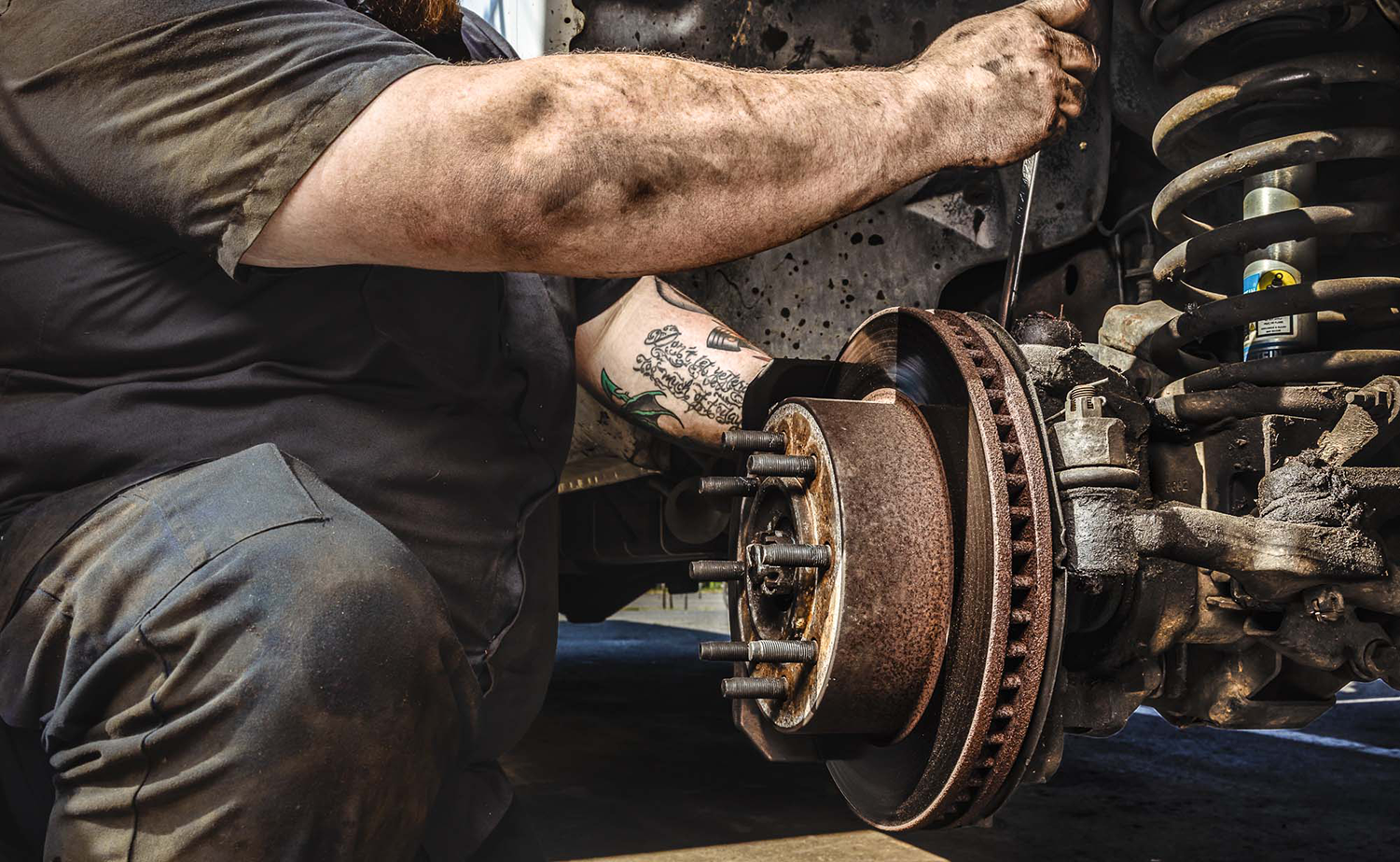
When an air-brake truck pulls to one side, stops long or shows a brake adjustment indicator past its mark, the first thing our technicians do is measure pushrod stroke at every wheel end. Too much stroke means less braking force. The second thing we do matters more: find out why the brake went out of adjustment, because on a modern truck it should not happen on its own.
How a drum air brake works
Most heavy trucks and trailers on the road run S-cam drum brakes. When the driver presses the pedal, air pushes a diaphragm in the brake chamber, the chamber's pushrod moves the slack adjuster, the slack adjuster rotates the S-cam, and the cam spreads two brake shoes so their linings press against the inside of the drum. As linings wear, the pushrod has to travel farther to get the same braking force. The slack adjuster's job is to take up that extra travel. Some newer trucks use air disc brakes instead, which clamp pads against a rotor and adjust internally, but on most fleets we service, drums, shoes and linings are still the majority.
Automatic slack adjusters should not need adjusting
Every air-braked commercial vehicle built on or after October 20, 1994 must have automatic brake adjusters and, where the pushrod is exposed, a brake adjustment indicator, under FMCSA rule 49 CFR 393.53, which points back to NHTSA's air brake standard, FMVSS 121. An automatic slack adjuster takes up lining wear by itself.
That changes what an out-of-adjustment brake means. Bendix, one of the largest air brake makers, says a properly installed, working and lubricated automatic slack adjuster should never need manual adjustment after initial setup or a reline, and that manually re-adjusting one is more likely to mask the real problem, so the brake goes out again (Bendix Tech Tips, via Truck Parts & Service). Bendix's own service data for its Versajust adjuster carries the same warning: excessive stroke points to a problem with the adjuster, its installation or the foundation brake, which manual adjustment will not fix (Bendix SD-05-4630).
So if a driver or a quick-lube shop has been "adjusting the slacks" at every PM, the truck has a problem nobody has found yet.
What our technicians check, wheel end by wheel end
A brake job at our shops starts with measurements, not parts.
- Pushrod stroke at each wheel end, measured with the brakes released and again on a full application, then compared with the limit for that chamber's type and size. The limits are set out in 49 CFR 393.47; a standard type 30 clamp chamber, common on drive axles, has a readjustment limit of 2 inches, and a long-stroke type 30 has 2 1/2 inches.
- Whether the automatic slack adjuster is actually adjusting, using the maker's test for that model.
- Lubrication of the slack adjuster, cam tube and clevis pins.
- Wear in the cam head, cam bushings and rollers, and the condition of return springs.
- Lining thickness and drum condition. On air drum brakes, 393.47 sets minimum lining thickness at the shoe center: 3/16 inch on a steering axle with a continuous strip of lining, and 1/4 inch on other axles, or the wear indicator if the lining is marked.
- Matching parts side to side. The same rule requires the brake chambers on each end of an axle to be the same size and the slack adjusters to be the same effective length. Mismatched parts after a roadside repair are a common reason a truck pulls.
Bendix lists improper lubrication and worn cam heads, bushings and rollers among the usual causes of an out-of-adjustment automatic slack adjuster (Bendix Tech Tips). Those are wear items. Replacing them, or the adjuster itself, is what keeps the brake in adjustment.
Why this is the brake problem inspectors find most
Brake adjustment is not a paperwork issue. During the Commercial Vehicle Safety Alliance's 2025 Brake Safety Week, inspectors placed 2,296 of 15,175 inspected vehicles out of service for brake violations, a 15.1% rate. The most-cited reason was that 20% or more of a vehicle's service brakes had an out-of-service condition, which accounted for 52.2% of those orders. On a five-axle tractor-trailer with ten brakes, two bad brakes is enough.
The pattern is the same outside brake-focused events. In CVSA's 2025 International Roadcheck, brake systems and the 20% defective-brakes rule together made up 41.1% of all vehicle out-of-service violations.
What the driver notices, and what it usually means
Brake wear comes on slowly, so drivers tend to describe a feeling, not a failure. Here is how we read the common reports:
- Pulls to one side when braking. Uneven stroke from side to side, a seized or worn adjuster, mismatched chambers or slack lengths, or contaminated linings on one side.
- Longer stops or a pedal that needs more pressure. Several brakes past their stroke limit, worn linings, or an air supply problem.
- Adjustment indicator past its mark on a walk-around. Measure that wheel end before the next trip. It is a visible early warning that the brake is close to its limit.
- Brakes that drag or run hot after a manual adjustment. Someone has over-adjusted to cover a worn component.
How often to check
Even without warning signs, brakes need regular service. We build brake checks into every scheduled preventive maintenance visit on Class 4 to 8 trucks and trailers. A simple service can take as little as 15 minutes, while replacing a whole brake system can take several hours, and opening up the brakes sometimes uncovers other problems. Lining life depends on how and where the truck runs: hard braking and town driving with frequent stops wear linings faster than long highway runs.
Who does the work matters too. FMCSA requires that anyone responsible for brake inspection, maintenance or repair on a carrier's trucks be qualified by training or at least a year of brake experience (49 CFR 396.25). That is worth asking any shop about.
When to call us
If a truck is pulling, stopping long or showing an indicator past its mark, call the shop nearest you before the next run. Tell us which unit it is, what the driver felt, and whether anyone has adjusted the brakes recently. That last detail often tells us where to look first.
Statesville: 704-960-8951. Bessemer City (serving Gastonia and Gaston County): 980-391-4100. Monroe: 980-396-6750. Emergency service is available at all three shops Monday to Friday, 7:00 AM to 5:00 PM, on each shop's own number. You can also email marketing@gallaherfleetsolutions.com or request service at www.gallaherfleetsolutions.com/contact, and we will get back to you the same business day. See our heavy-duty brake repair page for the full service.