
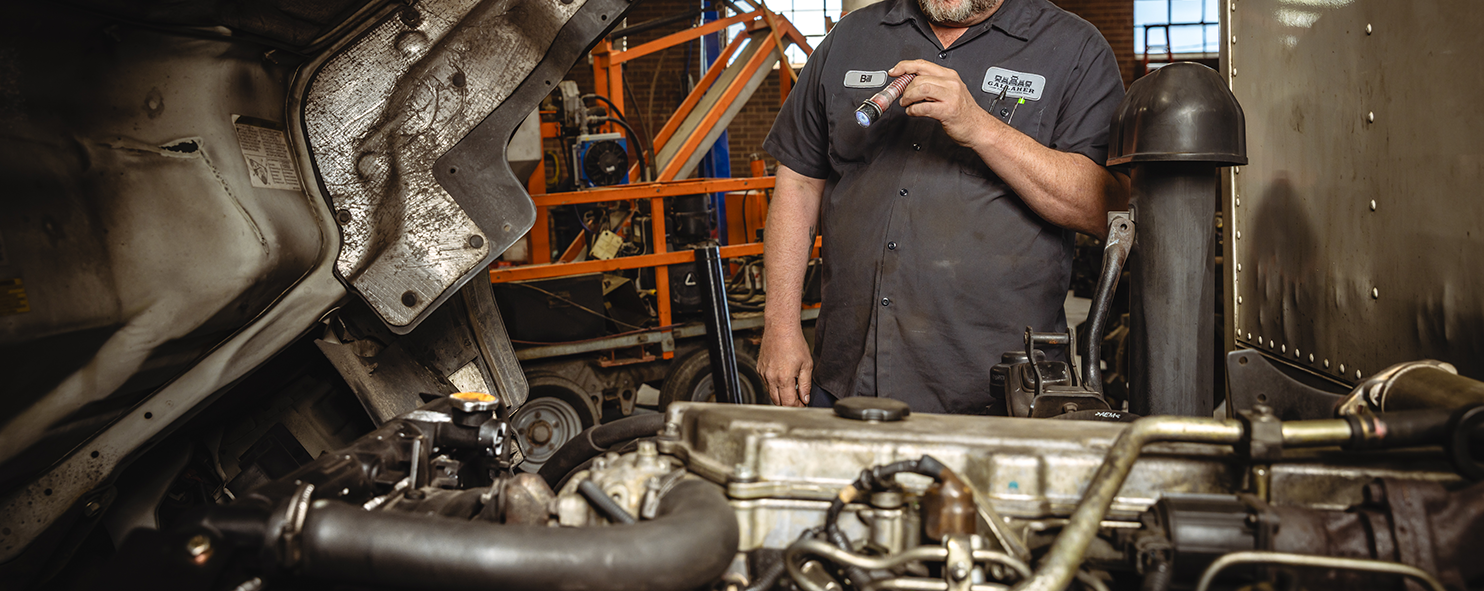
A good driver pre-trip inspection is short, consistent and aimed at the things that actually take trucks off the road. Federal rules already require drivers to check the key safety parts before driving and to report defects at the end of the day. Roadside inspection data shows which of those parts fail most: brakes, tires and lights. Build your fleet's pre-trip and weekly checks around those, and drivers will catch most problems while they are still cheap to fix.
What the rules require of drivers
Three FMCSA rules set the baseline:
- Before driving: a driver may not drive a commercial vehicle unless satisfied that the service brakes and trailer brake connections, parking brake, steering, lights and reflectors, tires, horn, wipers, mirrors, coupling devices, wheels and rims, and emergency equipment are in good working order (49 CFR 392.7).
- Before driving, part two: the driver must be satisfied the truck is in safe operating condition and review the last driver vehicle inspection report, if one was required, signing it to acknowledge any repairs (49 CFR 396.13).
- End of day: drivers must prepare a written report on each vehicle covering the same list of parts, identifying any defect that would affect safety or cause a breakdown. Drivers do not have to prepare a report if they find no defect. The carrier must repair listed safety defects, or certify repair is unnecessary, before the truck runs again, and keep the reports for three months (49 CFR 396.11).
That list is your pre-trip checklist's skeleton. The data tells you where to spend the most attention.
What inspectors put trucks out of service for
During the Commercial Vehicle Safety Alliance's 2025 International Roadcheck, inspectors placed 18.1% of inspected vehicles out of service. The top vehicle violation was brake systems, at 24.4% of vehicle out-of-service violations. Tires were second, with 2,899 violations, or 21.4%. Combined with trucks where 20% or more of the brakes were defective, brake-related problems made up 41.1% of all vehicle out-of-service violations. Lights and cargo securement rounded out the top five.
The lesson for a pre-trip program is simple. Brakes, tires and lights deserve the most of a driver's time.
The walk-around, every trip
This is not a replacement for a full inspection. It is a focused check a driver can do in a few minutes, every time.
Brakes and air system
- Listen for air leaks with the system charged and the engine off.
- Look at brake chambers, hoses and slack adjusters for damage, chafing or anything hanging loose.
- On trucks with brake adjustment indicators, check that each one is within its mark.
- Check that glad hands and trailer air lines are connected, sealed and not rubbing.
- Test the parking brake and confirm air pressure builds normally.
Tires and wheels
- Look for cuts, bulges, exposed cord and flat or low tires.
- Check tread depth. Under 49 CFR 393.75, steer tires need at least 4/32 inch of tread and other tires at least 2/32 inch.
- Look for loose, missing or rust-streaked lug nuts and oil seeping from hubs.
Lights and reflectors
- Headlights, turn signals, brake lights, clearance and marker lights, and reflective tape on the trailer.
Leaks and the rest of the list
- Oil, coolant, fuel or hydraulic fluid under or around the truck.
- Steering, horn, wipers, mirrors, coupling devices and emergency equipment, including a working fire extinguisher.
- Cargo loaded and secured.
Paperwork
- Driver's license and medical card, current and on hand.
- Hours of service records accurate and complete.
- Proof of the current annual inspection on the vehicle.
Weekly checks with the truck parked
Some checks are easier with time and a level, parked truck:
- Engine oil, coolant, power steering and washer fluid levels, with the engine off.
- Draining air tanks if they are not equipped with automatic drains.
- A closer look at belts, hoses and wiring for cracks, chafing and loose connections.
- Battery terminals for corrosion.
- A walk-around of the trailer underside, including suspension and frame.
The most important part of any check is writing it down. A note on a driver report is what lets the shop act on a small issue before it becomes a breakdown or a roadside violation.
What happens at a roadside inspection
An inspection can happen anytime, anywhere: on the side of the road, at a weigh station or at a truck stop. If a truck passes a full inspection with no violations, it receives a CVSA decal good for three months. Violations that are not serious still mean the truck does not pass and must be fixed, and they can count against Compliance, Safety, Accountability scores for both the driver and the carrier, which FMCSA publishes through its CSA program. An out-of-service violation keeps the driver off the road until it is fixed and documented.
Back the drivers up with regular inspections
Pre-trips catch what a driver can see. They do not replace a full inspection by a qualified technician. Under 49 CFR 396.17, every commercial vehicle in a combination, trailers included, needs a passed periodic inspection within the last 12 months, with proof on the vehicle.
We perform DOT inspections at all three shops, and our mobile units can do DOT inspections and DOT-related repairs on site. Pair them with preventive maintenance and most problems get found in the bay instead of at the scale.
Statesville: 704-960-8951. Bessemer City (serving Gastonia and Gaston County): 980-391-4100. Monroe: 980-396-6750. You can also email marketing@gallaherfleetsolutions.com or request service at www.gallaherfleetsolutions.com/contact, and we will get back to you the same business day. See DOT inspections for what each inspection level covers.